ExplainersData explainer
Reading gambling revenue without confusing it with profit
What gross gambling yield measures, how the stakes-and-prizes calculation works, and why a GGY headline is not a profit figure or a player-return forecast.
Start with the definition, not the headline
Gross gambling yield, or GGY, is a measure used in Gambling Commission reporting. It describes an amount associated with licensed gambling activity after relevant prizes or winnings are deducted. A headline about rising GGY therefore needs a different reading from a headline about company profit, customer deposits or the total amount staked.
The Commission’s definitions express the calculation as stakes plus other amounts accruing directly from the licensed activity, excluding VAT, less prizes or winnings, for the relevant period. The second component matters: GGY is not always adequately described by a two-number subtraction. The detailed reporting guidance determines which transactions belong in the calculation.
A hypothetical calculation in pounds
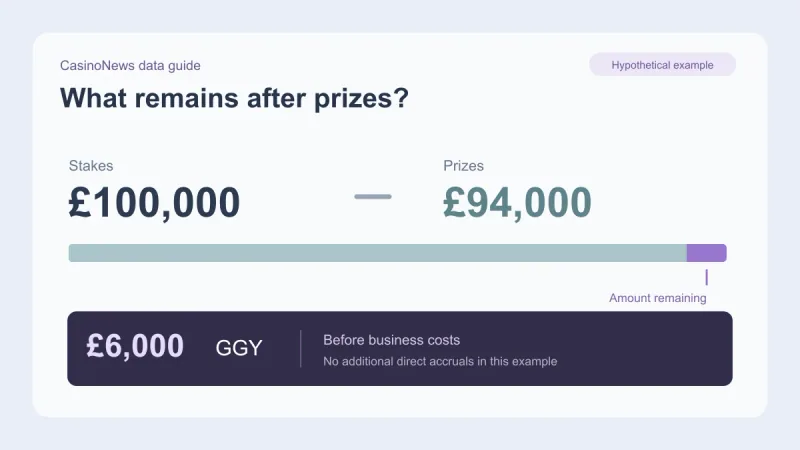
Consider an intentionally simplified example with £100,000 in relevant stakes, no additional direct accruals and £94,000 in prizes for the same reporting period. The result is £100,000 plus £0 minus £94,000, giving £6,000 of GGY. These figures are invented to show the arithmetic; they are not figures for a named business or a description of a typical gambling product.
The £100,000 and £6,000 answer different questions. One is the stake total in this example; the other is the amount remaining after the stated prize deduction. Reporting the larger number as the amount retained would erase the £94,000 paid in prizes. Reporting £6,000 as final profit would introduce a different error.
Why business costs change the interpretation
The example’s £6,000 does not tell us the business’s final financial result. It supplies no figures for staff, premises, technology, financing or other costs. It also supplies no complete accounting treatment or tax information. The calculation cannot answer questions for which its inputs contain no evidence.
For illustration, if a separate, simplified comparison assumed £8,000 of relevant business costs against that £6,000 amount, subtraction would produce a £2,000 shortfall before any other adjustments. That second example is only an explanation of why a revenue-related measure is not profit. It is not a statutory accounts calculation, a valuation or financial advice.
Check the reporting boundary
The Commission’s regulatory-returns guidance specifies that it requires GGY rather than gross gambling revenue in those returns. It also distinguishes GB and non-GB reporting, including the customer’s physical location and the authority under which the activity occurs. A company’s worldwide revenue announcement may therefore have a different boundary from a Commission statistical series.
Before comparing two published numbers, write down the period, geography, products and definition attached to each. A quarterly amount and an annual amount are not directly interchangeable. Neither are a group-wide figure and a particular licensed activity. If a publisher has not explained those boundaries, the comparison needs qualification rather than an assumed match.
Treat published totals as data with a method
The Commission’s methodology explains that regulatory returns are checked, estimates may be used when returns are late and later information can lead to revisions. It also states that historical industry figures are not adjusted for inflation. Those details matter when an apparent change is being presented as evidence of growth.
GGY alone also cannot predict an individual customer’s experience or establish a guaranteed return. The hypothetical calculation aggregates the inputs supplied to it; it does not describe the distribution of outcomes among people. A careful reading keeps the metric, its reporting method and the claim being made about it separate.
Sources & reading
The documents behind this explanation. Historical sources describe their own period.
Publication byline. Prepared with AI assistance; see our editorial standards.