RegulationVerification guide
Checking a Curaçao licence starts with the official record
A practical guide to the CGA register, domain-specific certificates and the limits of a licence check, using official sources checked in November 2026.
Start from the authority, then follow its links
A Curaçao Gaming Authority licence claim is something to verify against official records, rather than accept from a badge in a website footer. This guide explains how to organise that check. It does not assess or recommend any gambling business, and a matching record alone cannot settle every question about a website.
The CGA says Curaçao’s National Ordinance on Games of Chance, known as the LOK, took effect on 24 December 2024. Its current website links separately to the licence register, the Online Gaming Portal and new applications. On 11 November 2026, the portal link led to portal.cga.cw and a sign-in page. The public register is the more useful starting point for a reader checking a claim.
Match the legal entity and read the dates
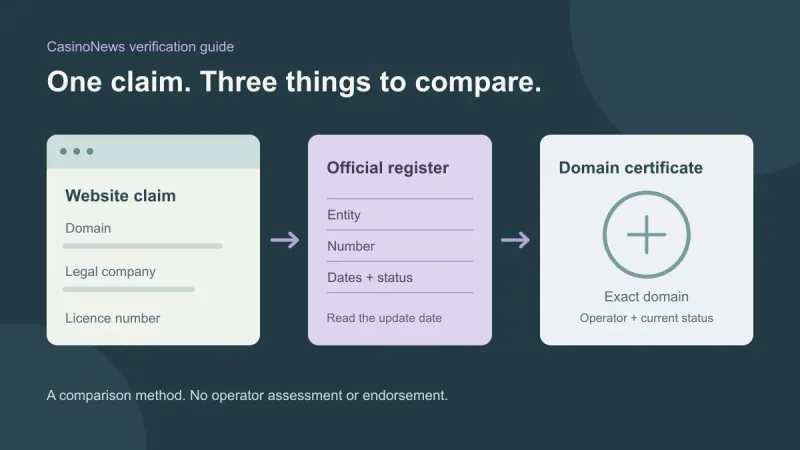
The online gaming register linked by the CGA when we checked was updated on 5 November 2026. Its columns identify the licensee, licence number, company registration number, B2B or B2C type, issue and expiry dates, and status. Search using the legal company named in the website’s terms, as well as the claimed licence number.
The register landing page warns that these overviews do not guarantee current licence validity. Treat the document as a dated record and read any status entry alongside the dates. A familiar trading name, a similar company name or a copied number is not enough to establish a match.
Distinguish a company licence from a domain certificate
The CGA’s certification policy distinguishes a License Certificate, which concerns a licensed entity, from a Certificate of Operation for a specific player-facing domain. A company’s licence certificate does not itself authorise a player-facing website. That distinction matters when someone presents a corporate credential as proof about a different web address.
For the Certificate of Operation seal, the policy specifies a destination at cert.cga.cw. The resulting certificate should identify the exact domain, operator and current licence status. The CGA says a different domain indicates another operator’s certificate and should be treated as unauthorised or fraudulent. Read the destination address and certificate contents rather than relying on the appearance of the seal.
Keep a short record of what agrees and what does not
A practical comparison needs three headings: the website’s claim, the official record and the unresolved difference. Note the full domain you visited, the legal entity it names, the licence identifier and when you checked. Keeping these details together makes it easier to explain a mismatch without overstating what you have established.
For example, a matching company name paired with a different certificate domain leaves the website claim unresolved. An unavailable page also leaves a gap; it is not evidence that the claim has been confirmed. Avoid filling either gap with assurances from the same website you are trying to verify. Use independently reached official contact details if clarification is needed.
Keep verification separate from complaints and local rules
This method answers a narrow question: whether the documents you can inspect support a particular licensing claim. It does not determine your local legal position, predict a withdrawal, or decide a dispute. Those questions require their own evidence and applicable rules.
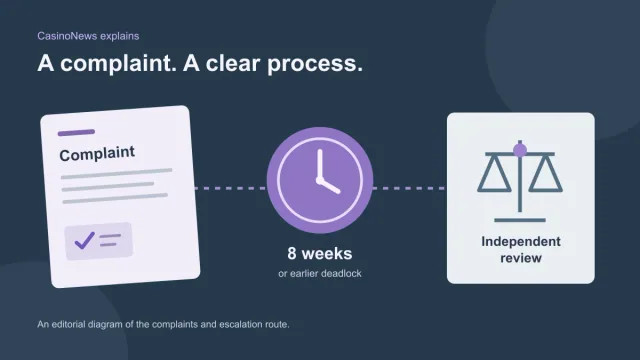
Our general licence-check guide provides the broader comparison framework. The linked complaints guide describes Great Britain specifically; its procedures should not be assumed to apply to a Curaçao-licensed business. Preserve that jurisdictional distinction when reading advice about escalation or independent review.
Sources & reading
The documents behind this explanation. Historical sources describe their own period.
Publication byline. Prepared with AI assistance; see our editorial standards.