LotteriesReader guide
A real lottery win does not authenticate a Julie Leach message
What Michigan Lottery and ESET establish about Julie Leach and impersonation emails, plus practical steps for handling an unsolicited prize or donation message.
What the official announcement establishes
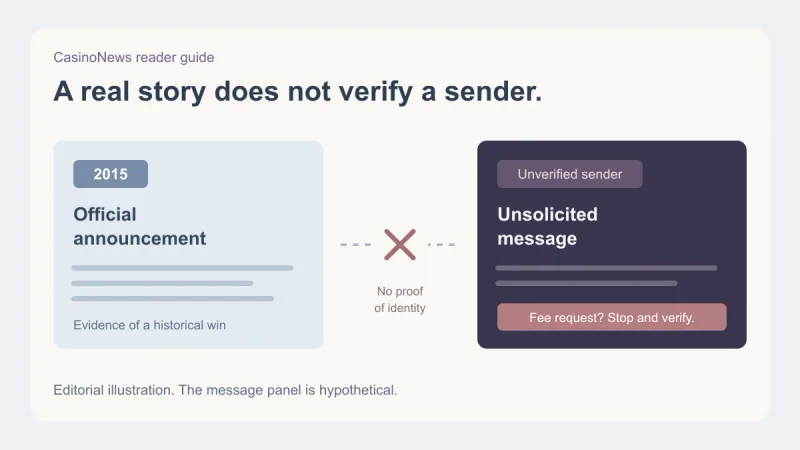
Julie Leach is a real Michigan lottery winner whose name has been used in impersonation messages. Michigan Lottery’s announcement of 6 October 2015 identifies Leach of Three Rivers as the winner of the $310.5 million Powerball jackpot drawn on 30 September. That historical announcement establishes the win; it does not authenticate a later email, social profile or promised donation.
A useful first distinction is between a fact about a person and a claim made by someone using that person’s name. A sender can point to a genuine news report without being connected to its subject. Finding the original announcement therefore answers only the historical question, not who controls the account contacting you.
What ESET actually documented
On 20 November 2023, ESET Ireland analysed an Irish-language phishing email pretending to come from Leach. It described a supposed $500,000 gift to selected recipients and noted that the requested reply address differed from the sending address. ESET treated the public lottery story as material used by impersonators, not as evidence that Leach was involved.
Its analysis explained how follow-up contact could lead to demands for advance costs or requests to sign in through fraudulent confirmation messages. This is evidence about a documented impersonation method. It does not prove that every message using the name comes from one group, or establish the identity of the person behind a message you have received.
Look at the requested action, not the promised amount
The US Federal Trade Commission identifies demands for payment to release a prize as a scam warning. It also warns against providing account or sensitive personal information in response to unsolicited prize claims. A request labelled as a processing charge or tax should not become more credible because a message includes a familiar name.
Consider a hypothetical message that links to a genuine winner announcement, then asks for a transfer to unlock a donation. The announcement and the transfer request are separate pieces of evidence. The first cannot verify the second. The same reasoning applies to a profile photograph, a copied interview or a screenshot offered as supposed confirmation.
Stop the conversation and verify independently
The FTC advises against replying to suspicious prize messages or clicking their links. Where a message claims to represent an organisation, find that organisation’s contact details independently instead of using the details supplied by the sender. Pressure to act immediately is another warning sign identified in the agency’s guidance.
Preserve the message and its sender details if you need to report it. If money has already been sent, act promptly: the FTC’s guidance links to recovery steps and directs reports to ReportFraud.ftc.gov. If personal information has been misused, it points readers to IdentityTheft.gov. Recovery is not guaranteed by making a report.
Keep the conclusions proportionate to the evidence
The sources reviewed here do not establish Leach’s current wealth, her present personal circumstances or the authenticity of any alleged giveaway. They support a historical win and a documented case of others pretending to be her. Adding a current net-worth estimate would not help a reader assess an unsolicited payment request.
A useful report records what arrived, which account sent it, what action was requested and whether money or information was supplied. Describe the impersonation claim without attributing the conduct to the named lottery winner. Our related reading explains how to assess sources and why a formal gambling complaint is a different process from reporting a suspected scam.
Sources & reading
The documents behind this explanation. Historical sources describe their own period.
Publication byline. Prepared with AI assistance; see our editorial standards.