ExplainersReader guide
How self-exclusion fits into a wider plan to stop gambling
A sourced guide to self-exclusion in Great Britain, the difference between online and venue arrangements, and complementary blocking tools and support.
A formal step to create distance
Self-exclusion is an arrangement intended to help someone stop gambling. The Gambling Commission explains that a person can ask to be excluded from a gambling business or use a scheme covering multiple operators. It is a practical restriction with a defined scope, rather than a general promise that every possible route to gambling has disappeared.
The useful first question is what the arrangement covers: an individual business, online services or particular types of physical venue. A confirmation should be kept where it can be found later. Understanding that scope makes it easier to identify additional barriers and support without assuming one registration does everything.
Online and venue arrangements are different
GamCare’s self-exclusion guidance identifies GAMSTOP as a free option for UK residents excluding from gambling businesses licensed in Great Britain online. It also describes arrangements for individual websites or apps, individual premises and schemes covering groups of venues. These routes address different settings, so online exclusion should not be read as a universal premises ban.
Use the relevant scheme’s current instructions to understand its coverage, registration details and available periods. If a person uses more than one setting, they may need to consider more than one arrangement. Keeping a simple list of confirmations can make the boundaries visible and reduce reliance on memory when reviewing what is already in place.
What a business is expected to do
The Commission says a business must close the self-excluded customer’s account, return money held in it and remove the person’s details from its marketing databases. It must also take reasonable steps to prevent gambling during the exclusion. These responsibilities are part of the published framework, not a claim that implementation can never fail.
If gambling takes place despite an exclusion, the Commission advises telling the business and says information can also be reported to the regulator. Preserve the confirmation and relevant dates. Reporting a failure helps identify what happened; it should not be described as an automatic refund route or proof of a particular outcome.
Add barriers that address different routes
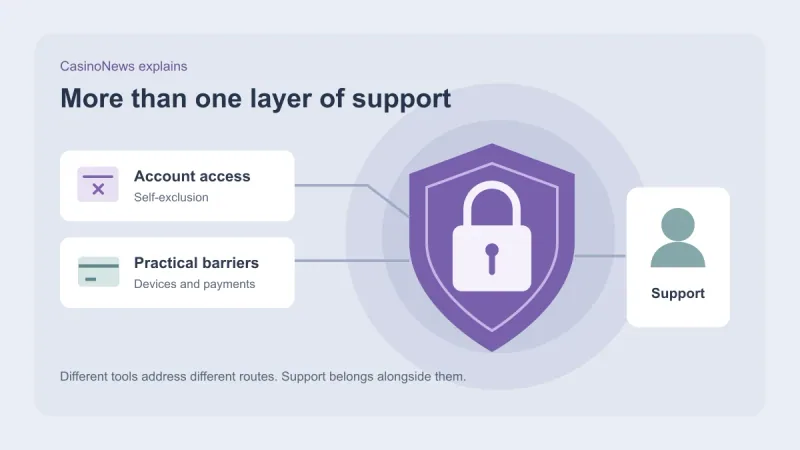
GamCare describes blocking software as a way to restrict access to gambling websites or services on devices. That is a different layer from an exclusion arrangement with a business or scheme. Its guidance also points to gambling-payment blocks offered through banks and building societies. The availability and operation of a particular tool need to be checked with its provider.
Think of these as separate questions: which accounts are restricted, which devices have an access barrier and which payment methods have a block? Writing down those answers can reveal an overlooked device or account. This is an organisational exercise, not a recommendation for a particular product or an assurance that a collection of tools is infallible.
Keep support alongside the practical controls
GamCare emphasises combining practical tools with support. A barrier can make an action harder while a conversation addresses what is happening around it. Its website provides routes to advisers and information for people affected by gambling, including affected family members or friends. Seeking that support does not require waiting for a technical control to fail.
This guide concerns Great Britain and does not assume the same schemes or rules apply elsewhere. Use current local information if another jurisdiction is involved. If gambling is affecting everyday life or wellbeing, the linked support resources are a useful starting point; this general explanation is not an individual treatment plan.
Sources & reading
The documents behind this explanation. Historical sources describe their own period.
Publication byline. Prepared with AI assistance; see our editorial standards.